Frequently Asked Questions:
What Is FLS?
Program Mission
To provide surgical residents, fellows and practicing surgeons an opportunity to learn the fundamentals of laparoscopic surgery in a consistent, scientifically accepted format; and to test cognitive, surgical decision-making, and technical skills, all with the goal of improving the quality of patient care.
Program Overview
FLS is a comprehensive web-based education module that includes a hands-on skills training component and assessment tool designed to teach the physiology, fundamental knowledge, and technical skills required in basic laparoscopic surgery. Click here for an in-depth article "Fundamentals of Laparoscopic Surgery - Its Time Has Come".
FLS was designed for surgical residents, fellows and practicing surgeons to learn and practice laparoscopic skills to have the opportunity to definitely measure and document those skills. The FLS Test measures cognitive knowledge, case/problem management skills and manual dexterity. The FLS program content has been endorsed by the American College of Surgeons (ACS) and is a joint educational offering of SAGES and ACS. FLS is also CME accredited.
Click here to download Frequently-Asked-Questions about FLS.
Valuable as a foundation or supplement to any current MIS curriculum, FLS is also an appropriate learning tool for disciplines such as gynecology and urology, as FLS is not procedure-specific Click here to download a brochure.
FLS Objectives
- To improve the quality of care received by patients undergoing laparoscopic surgery
- To set minimum standards for basic cognitive and technical skills used in performing laparoscopic procedures
- To provide surgeons practicing laparoscopy with standardized didactic information on the fundamentals of laparoscopic surgery and a tool to assist in development of judgment and manual skills
- To create an objective quantifiable measure to assess knowledge, judgment and manual skills in basic laparoscopic surgery
- To make available to hospitals and institutions a validated tool to measure the knowledge and skills fundamental to the performance of laparoscopic surgery
Program Description
FLS establishes a standard set of didactic information and manual skills serving as a basic curriculum to guide surgical residents, fellows and practicing surgeons in the performance of basic laparoscopic surgery. By mastering the curriculum and gathering of skills in this inanimate modality, it is expected that surgical residents and surgeons will initiate and carry out their performance of laparoscopy more effectively, with greater skills, greater safety, and with lower complication rates than previously. The specific aim of FLS is that the knowledge and skills gained by those who master the FLS curriculum will improve the quality and safety of surgical care delivered to their patients.
Click here to download an important Information Bulletin with a complete description of FLS, and policies concerning the FLS test.
Technical Skills Training Curriculum
The FLS program may be effectively used to teach and assess both cognitive and technical skill aspects related to laparoscopic surgery. Over the past two years, SAGES FLS committee members have developed a technical skills curriculum specifically designed for use in residency training programs. The curriculum is proficiency-based, whereby trainees are oriented to the materials and self-practice until expert-derived performance levels are reached.
Residents may practice as much or as little as needed in order to acquire the validated skills incorporated into the FLS modules. The video materials serve as a robust source of feedback for the learner and additional proctoring is considered optional. This protocol ensures that all trainees achieve an excellent level of performance, and has correlated with a uniform successful passing score according to the FLS technical skills testing criteria. We recommend this curriculum for all resident levels. Surgery interns may benefit by mastering these skills early in their training, such that they are better prepared for opportunities in the operating room and can undergo additional training throughout their residency as needed. Similarly, mid-level and senior residents may benefit by ensuring that all trainees have suitable skills to perform a wide array of laparoscopic procedures.
We have partnered with other ongoing national initiatives, and this curriculum is now part of the Basic and Advanced Laparoscopic Skills Modules included in the ACS/APDS National Skills Curriculum Project; detailed information concerning these modules is available through the ACS website http://elearning.facs.org .
Download technical skills proficiency-based curriculum.
Components
FLS consists of:
- Web-based study guides;
- hands-on manual skills practice and training via the FLS Laparoscopic Trainer Box; and
- an assessment tool that measure your cognitive and technical skills.
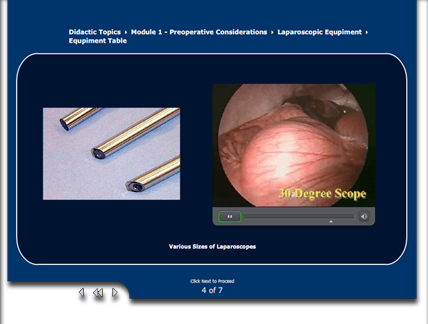
The Online study guides cover didactics, interactive patient scenarios and manual skills training, containing printable text reviews and practice questions.
Online access is now available to all new program participants. The online system allows program coordinators to administer and closely track the progress of their individual users.
If your program is currently enrolled in the online system please download the following instruction manual(s):
FLS Online Instruction Guide - Viewing Online Content; for all general users
FLS Online Instruction Guide - Program Administration; for Program directors/coordinators only
Previous FLS Program participants will soon be given the opportunity to upgrade to the online system.
The FLS Laparoscopic Trainer Box allows practice of technical skills to improve dexterity and psychomotor skills. The simulated laparoscopic manipulation includes instrument navigation, coordination and cutting or knot-tying. Click here for a written desciption of the five FLS manual skiils. Please also refer to the Technical Skills curriculum, and, the skill demonstration videos in the Online Study guides.
The Assessment Component is a two-part, proctored exam that covers cognitive knowledge and manual skills.
The cognitive component is a timed, 75-question multiple-choice exam administered via computer. It is designed to test the understanding and application of the basic fundamentals of laparoscopy with emphasis on clinical judgment or intraoperative decision-making.
FLS is currently phasing in a new on line testing process to administer this component. If you're test center is currently using the on line process please download the following instruction manuals:
On Line Testing: Test Center User Guide * For test centers only*
On Line Testing: Test Taker Registration Guide
The manual skills component evaluates skills based on efficiency (speed) and precision (accuracy) of the surgeon's maneuvers using the FLS Laparoscopic Trainer Box. The test consists of five non-procedure specific simulation exercises incorporating most of the psychomotor skills necessary for basic laparoscopic surgery.
FLS Benefits
- Helps to address case-mix inequalities in a residency program
- Permits learning minimally invasive techniques in a safe environment without putting patients at risk
- Refreshes techniques for laparoscopic surgeons returning to practice after an extended absence
Exam Eligibility
FLS candidates are
- Junior and senior surgical residents and fellows enrolled in an accredited program of surgical education
- Board eligible/certified practicing surgeons
- Residents and fellows in an accredited program of gynecology, urology, surgical oncology or other program that teaches laparoscopic procedures
- Board eligible/certified practicing gynecologists, urologists and other physicians who perform laparoscopic procedures.
After completion of the self-instructional web-based program, eligible test candidates may schedule the FLS Exam.
Supporting Literature
- Sroka G, Feldman LS, Vassiliou MC, Kavena PA, Fayez R, Fried G. Fundamentals of Laparoscopic Surgery simulator training to proficiency improves laparoscopic performance in the operating room - a randomized controlled trial. Am J Surg 199: 115-120, 2010..
- Castellvi AO, Hollett LA, Minhajuddiin A, Hogg DC, Tesfay ST, Scott DJ. Maintaining proficiency after Fundamentals of Laparoscopic Surgery training: A 1-year analysis of skill retention for surgery residents. Surgery 2009; 146: 387-393.
- Feldman LS, Cao J, Andalib A, Fraser S, Fried GM. A method to characterize the learning curve for performance of a fundamental laparoscopic simulator task: Defining "learning plateau" and "learning rate". Surgery 2009; 146: 381-6.
- Scott DJ, Ritter EM, Tesfay ST, Pimental EA, Nagji L, Fried GM. Certification pass rate of 100% for fundamentals of laparoscopic surgery skills after proficiency-based training. Surgical Endoscopy 2008 10.1107/x00464-0089745-y (online).
- Ritter EM, Scott DJ (2007) Design of a proficiency-based skills training curriculum for the Fundamentals of Laparoscopic Surgery. Surg Innov 14; 107, 2007.
- Swanstrom LL. Fried GM. Hoffman KI. Soper NJ. Beta test results of a new system assessing competence in laparoscopic surgery. Journal of the American College of Surgeons; 202(1): 62-9, 2006.
- Korndorffer Jr JR, Dunne JB, Sierra R, Stefanidis D, Touchard CL, Scott DJ. Simulator training for laparoscopic suturing using performance goals translates to the OR. J Am Coll Surg, 201:23 – 29, 2005.
- Stefanidis D, Sierra R, Markley S, Korndorffer Jr JR, Scott DJ. Proficiency maintenance: impact of ongoing simulator training on laparoscopic skill retention. J Am Coll Surg, 202:599 – 603, 2006.
- Stefanidis D, Sierra R, Korndorffer Jr JR, Dunne JB, Markley S, Touchard C, Scott DJ. Intensive CME course training on simulators results in proficiency for laparoscopic suturing. Am J Surg, 191:23 –27, 2006.
- Dauster B, Steinberg AP, Vassiliou MC, Bergman S, Stanbridge DD, Feldman LS, Fried GM: Validity of the MISTELS Simulator for Laparoscopy Training in Urology. J Endourol. Jun; 19:541-5, 2005.
- Fraser SA, Feldman LS, Stanbridge D, Fried GM: Characterizing the learning curve for a basic laparoscopic drill. Surgical Endoscopy, 19(12): 1572-8, 2005.
- Fried GM, Feldman LS, Vassiliou MC, Fraser SA, Stanbridge D, Ghitulescu G, and Andrew CG. Proving the value of simulation in laparoscopic surgery. Ann Surg 2004; 240: 518-528.
- Peters JH, Fried GM, Swanstrom LL, Soper NJ, Sillin LF, Schirmer B, Hoffman K and the SAGES FLS Committee. Development and validation of a comprehensive program of education and assessment of the basic fundamentals of laparoscopic surgery. Surgery 2004; 135: 21-27
- Feldman LS, Sherman V, Fried GM. Using simulators to assess laparoscopic competence: ready for widespread use? Surgery 2004; 135: 28-42
- Feldman LS, Hagarty SE, Ghitulescu G, Stanbridge D, Fried GM. Relationship between objective assessment of technical skills and subjective in-training evaluations in surgical residents. J Am Coll Surg 2004; 198:105–110
- Fraser SA, Klassen DR, Feldman LS, Ghitulescu GA, Stanbridge D, Fried GM. Evaluating laparoscopic skills; setting the pass/fail score for the MISTELS system. Surgical Endoscopy 2003; 17(6): 964-967
- Keyser EJ, Derossis AM, Antoniuk M, Sigman HH, Fried GM. A simplified simulator for the training and evaluation of laparoscopic skills. Surgical Endoscopy 2000; 14: 149-153
- Fried GM, Derossis AM, Bothwell J, Sigman HH. Comparison of laparoscopic performance in vivo with performance measured in laparoscopic simulator. Surgical Endoscopy 1999; 13: 1077-1081
- Derossis AM, Antoniuk M, Fried GM: Evaluation of laparoscopic skills: a 2-year follow-up during residency training. Canadian Journal of Surgery 1999; 42:293-296
- Derossis AM, Fried GM, Abrahamowicz M, Sigman HH, Barkum JS, Meakins JL. Development of a model for training and evaluation of laparoscopic skills. American Journal of Surgery 1998; Vol.175: 482-487
- Derossis AM, Bothwell J Sigman HH, Fried GM. The effects of practice on performance in a laparoscopic simulator. Surgical Endoscopy 1998; 12: 1117-1120
Why Take the FLS Test?
Individual Surgeons
We believe FLS will set the standard for laparoscopic surgery. Surgeons are increasingly required to document their competency. FLS offers surgeons the opportunity to assess and document their own knowledge and skills before they are required to.
FLS indicates whether or not a practicing surgeon possesses the basic knowledge and skills fundamental to the performance of laparoscopic surgery.
Many surgeons who were already in practice during the advent of the laparoscopic revolution learned basic information and skills that were still a “work in progress”. Review and test yourself now on the uncontroverted knowledge and skills set that enhances patient safety and reduces risks for the surgeon.
Surgical Residency Program Directors
With the upcoming launch of the Covidien Educational Fund, made possible by a generous $1.8M multi-year gift from Covidien, access to the FLS curriculum, test vouchers and an FLS Trainer Box will be provided at no cost to qualified surgical residency programs and fellowships in North America. For more information visit the Covidien Educational Fund page.
FLS provides objective evidence to residency programs that an individual resident has gained the basic knowledge and skills fundamental to the performance of laparoscopic surgery before the resident completes their program.
There are a variety of easy ways to provide FLS to all residents that are headed to general surgery:
- Residents may buy an individual program, study at home and then take the test at a Test Center.
- Your Program can purchase an education package that includes the Online study guide and the option for group testing either at your institution or at a regional Test Center.
- Use the Covidien Educational Fund to get free access to the FLS Online study guides, and a visit from an FLS certified test proctor for surgical residents
Department of Surgery
Education has become increasingly more diffi cult to provide to one’s hospital staff. FLS is a complete and comprehensive educational package covering the basics of laparoscopic surgery.
FLS testing for your full-time surgical staff and attendings can give you an advantage with contracting, provides a credentialing tool and makes patients feel more confident.
FLS is designed to make a Department Chair’s life easier. FLS can be tailored to your institution. A variety of packages are available for one or for many. FLS provides you with a tool to run a more efficient department.